The Year I Met My Most Broken Self
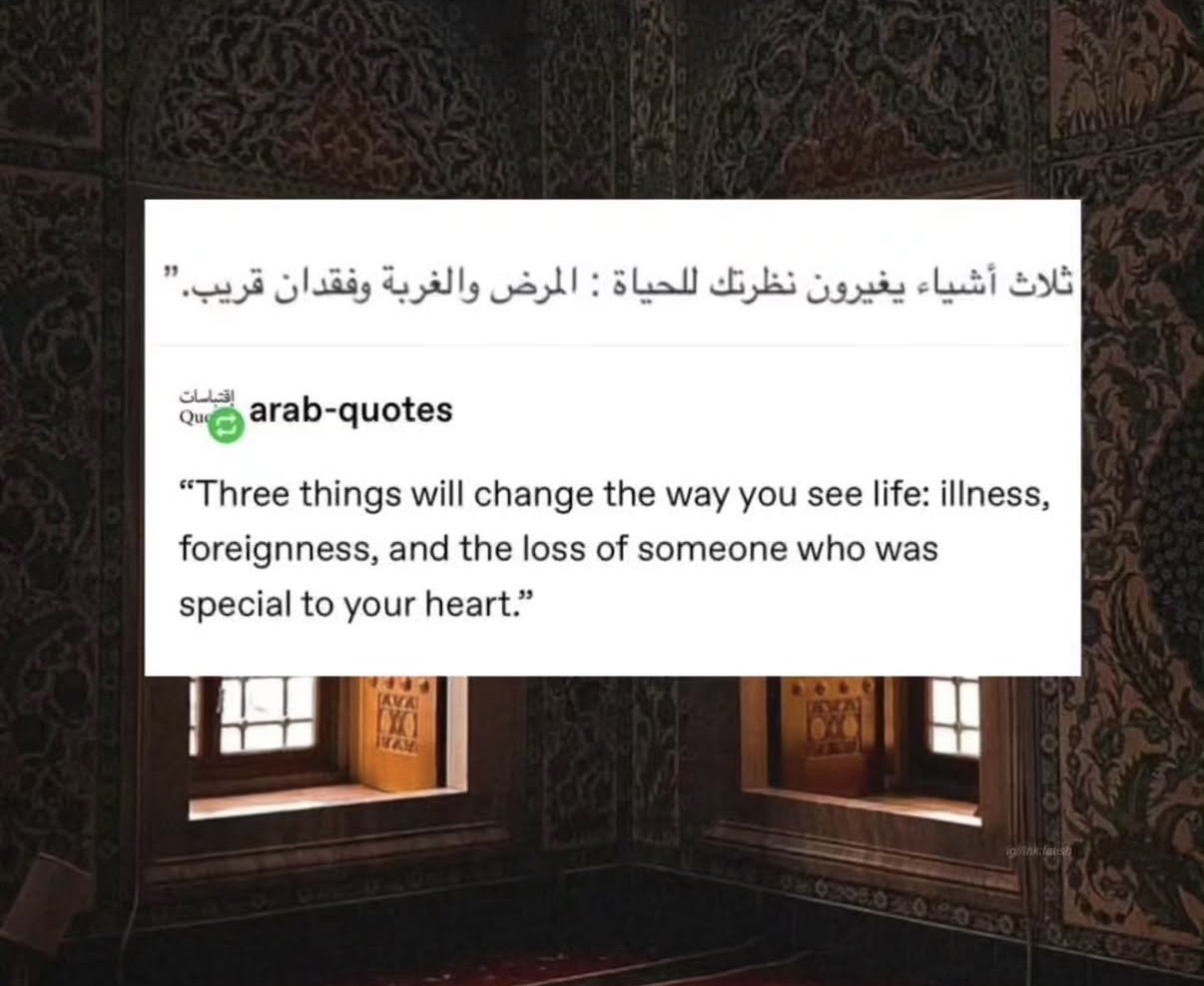
ثلاث أشياء يغيرون نظرتك للحياة: المرض والغربة وفقدان قريب
Three things will change the way you see life: illness, exile, and the loss of someone close to your heart.
— Arabic saying
I came across that line in an Instagram post on a random Monday morning and scrolled past it, the way you scroll past most things. Then I scrolled back. It read like a summary of my year.
Enough has happened over the last two years to fill a book. This is the part I keep returning to.
Loss
There are people you assume you’ll grow old with. No one promises it. You just picture them there. She was one of those people for me. I thought we would grow old as friends, and so did my wife.
She knew things about me that very few people know. I told her stories I had never said out loud to anyone else. The friendship felt permanent enough that I never thought of it as something I had to maintain.
Then, over about two months, we spoke less. I was dealing with a lot, and when I’m dealing with a lot, I go quiet. I pull inward, try to handle it, and resurface when I’m steady again. I assumed the friendship was strong enough to hold that silence.
By the time I reached out to ask what had happened between us, we had both spent too long making sense of the silence on our own.
For a while, I built a case in my head. I was struggling. Why hadn’t she asked me what was wrong? Why had we spoken through my wife instead of to each other? That version of the story let me feel wronged, which was easier than feeling helpless. It also left out my silence.
She was hurt that I hadn’t told her I was struggling. What felt to me like protecting people from my mess felt to her like being told she wasn’t close enough to see it. I can understand that now, even if I couldn’t then. We both let the distance speak for us, and by the time we finally spoke for ourselves, we heard different stories.
I don’t think either of us wanted this ending. I went quiet, and she felt shut out. By the time we understood each other’s side, neither of us knew how to undo it.
As I write this, it has been six months since we last spoke. Six.
I lost another friendship this year, one that had lasted fourteen years. Months of misunderstandings ended with her telling me I needed to learn how to be a friend, and after that I stepped away. Ending the friendship also meant I stopped seeing her dog. My wife and I had gone with them to pick him up at the airport, and somewhere along the way I started thinking of him as one of ours. He would light up when he saw me, with no idea that anything had become complicated between the adults around him. None of it was his fault. He is the best pupper, and I still miss him.
She said I needed to learn how to be a friend partly because I hadn’t told her about That Software House (TSH). That hurt because she usually knew everything about my life, and somehow I had left this out. Kaizen was still my main focus. TSH was an experiment with a co-founder to see if we could make consulting work. After six to eight months of looking for clients and coming up empty, we shut it down around the time of that conversation.
Illness
I found out my dad was dealing with a health issue a couple of weeks before that conversation. A month after it, we learned it was cancer.
I live in California. My parents live in Bangalore. That distance is one of the main reasons I built Kaizen Health, which keeps the records, questions, and family updates behind someone’s care in one place. I never imagined I’d become a test user for my own app this way.
I flew to Bangalore to be with my family. It was my first time seeing an oncology ward in India from the caregiver’s side. I learned the vocabulary I never wanted. I learned the smell of the hospital. I heard children crying while they underwent chemo. Some adults sat through treatment alone. Others had their entire family waiting for the day-care chemo session to finish.
It messed with me more than I knew how to say. I still had to keep track of what the doctors said and sound calm on the phone.
This was exactly the kind of thing I would have told her. She was the person I’d have called. Losing that friendship and learning about my dad became tangled together in my head, each making the other harder to carry.
My dad has now finished six rounds of chemo. We’re hoping that’s it. He’s been braver about all of it than I have.
Exile
That post was also the first time I saw the word ghurba. The closest meaning I found was estrangement: being a stranger in a place where you used to belong.
That is the best description I have for this year. I met the most broken version of myself: someone I didn’t recognise and didn’t particularly like, carrying things I would normally have put down somewhere.
I feel tired in a way that sleep cannot fix.
My wife and I talked about the friendship until neither of us had anything new to say. She had lost a friend too. We agreed to stop, but the conversation kept running in my head.
Work took a hit as well. I still opened the laptop, decided what mattered next, and answered whatever was in front of me, even when I did not trust myself to make another decision. I learned to sound certain when I wasn’t.
I spent the year doing by hand, for my own father, exactly what I’d built Kaizen to make easier. I called that research because the joke was easier than the explanation.
The hardest person to keep talking to was the person closest to me. My wife has been the most supportive partner through all of this. I never thought she would see me as weak. I kept asking myself how many times I could lay the same problems in front of her while she was dealing with things of her own.
I could say it once, twice, even ten times, and she would listen. Eventually I started hearing myself repeat the same fears without doing anything differently. She could support me, but she could not solve them for me.
That part was on me. I needed to act, find other outlets, and learn to compartmentalize without shutting her out. I also needed to leave enough room to be present for what she was carrying.
I kept working, making decisions, and trying to be a husband and a son. The work got done. I was still falling apart.
Where this leaves me
Going quiet did not spare the people I loved. It could make them feel locked out.
Some losses don’t come with a funeral. You grieve people who are still alive, still out there living, and there’s no ritual for that. You just carry it.
There has been joy in these months, too. Spending time with our friends’ one-year-old, my nephew in every way that matters, has been by far the most rewarding part. His parents have become family to us and have shown up for my wife and me consistently through all of it. I am grateful for the three of them and for the place they hold in our lives.
I also understand why people say to take things one day at a time. I used to hear that as something people said when they didn’t know what else to say. Some days, one day was as far ahead as I could manage.
Part of me wants to feel free from this version of my life. That feeling has also made me question what being free actually means. Maybe it isn’t about escaping everything.
I don’t even know why I’m writing this. Maybe it’s because I’ve heard so many people say that writing helps. Maybe I’ve spent so long living inside my own head that I need somewhere else to put all of this. Things still feel dark, and I don’t know how long it will take to find a way out. Or maybe I want it written down so that years from now, I can come back to it and remember exactly what this part of my life felt like.
“Oh, I have one, Johnny. I never give up.”
— Batman, Justice League: “Only a Dream”